electricians
Electrical Panel Upgrade Cost in New Jersey
Electrical panel upgrade cost in New Jersey runs $2,800 to $5,500 for a 200-amp swap and up to $10,000 with a new service. See what drives the price and how to save.
In This Article
Electrical Panel Upgrade Cost in New Jersey
A 200-amp panel upgrade in New Jersey costs roughly $2,800 to $5,500 for a standard replacement, and $6,000 to $10,000 or more when the job includes a new service entrance, meter socket, and utility coordination. Those numbers run above the national average because New Jersey electricians charge $110 to $175 an hour and every panel swap in the state requires a permit and inspection through the local construction office.
If your home still has a 100-amp panel, a Federal Pacific or Zinsco box, or a fuse panel, the upgrade is less about convenience and more about capacity and safety. Adding a heat pump, an EV charger, or an induction range to a 1960s split-level in Cherry Hill or a colonial in Morristown almost always pushes the old service past its limit.
What New Jersey Homeowners Are Paying Right Now
The most common job is a straight swap from an older 100-amp or 150-amp panel to a new 200-amp panel in the same location with the existing service entrance left alone. That typically runs $2,800 to $4,500 across most of the state, with the higher end in Bergen, Essex, and Monmouth counties where labor rates are steepest.
A full service upgrade is the bigger ticket. When the utility drop, meter base, and grounding system also need replacing, expect $5,500 to $9,500, and homes with underground service in newer developments in Somerset or Middlesex County can land higher because trenching or conduit work gets involved.
Sub-panels are the cheaper middle ground for many households. If your main panel has capacity but no open slots, a 60-amp to 100-amp sub-panel in a garage or basement runs $900 to $2,000 installed and solves the space problem without touching the utility service.
Typical Price Ranges by Job Type
Here is how the numbers usually break out for a single-family home in New Jersey, with permit fees included and no major surprises inside the walls:
| Job | Typical NJ cost |
|---|---|
| 100-amp to 200-amp panel swap, same location | $2,800 to $4,500 |
| 200-amp to 200-amp replacement of an unsafe panel | $2,200 to $3,800 |
| Full 200-amp service upgrade with new meter and mast | $5,500 to $9,500 |
| 400-amp service for a large home or full electrification | $9,000 to $15,000 |
| Add a sub-panel | $900 to $2,000 |
| Relocate the panel to a new spot | Add $1,500 to $4,000 |
These are approximate and assume the electrician can get a utility appointment within a normal window. Jobs that require a same-day disconnect and reconnect with PSE&G or JCP&L sometimes carry an extra fee for the scheduling.
Why New Jersey Costs More Than the National Average
Licensing is the first reason. New Jersey requires a licensed electrical contractor to pull the permit and perform the work, and the state licensing exam, bonding, and insurance requirements keep the pool of qualified contractors smaller than in states with looser rules. Fewer contractors means higher rates.
Permits are the second reason. Every municipality runs its own construction office under the state Uniform Construction Code, and electrical permit fees for a panel upgrade commonly run $75 to $250 depending on the town. The inspector will want to see the panel, the grounding electrode system, and the bonding, and if the old work does not meet current code, you pay to fix it.
Utility coordination is the third. PSE&G, JCP&L, Atlantic City Electric, and Rockland Electric each have their own process for a service disconnect, and some require a cut card from the municipal inspector before reconnecting. That means your electrician has to schedule around two outside parties, and that time gets built into the quote.
What Drives Your Quote Up or Down
The age of the house matters most. A 1920s home in Montclair or Collingswood with cloth-wrapped wiring, a rusted meter base, and no ground rod is a different job from a 1995 house in Marlboro where the panel just needs more amps. The older house often needs a new grounding electrode system, a new mast, and sometimes new feeder cable, and each adds several hundred dollars.
Panel location is the next factor. If the existing panel sits in a finished basement behind drywall, or in a closet where code no longer allows it, the electrician may need to relocate it, and that adds $1,500 to $4,000 for the new box, extended circuits, and drywall repair.
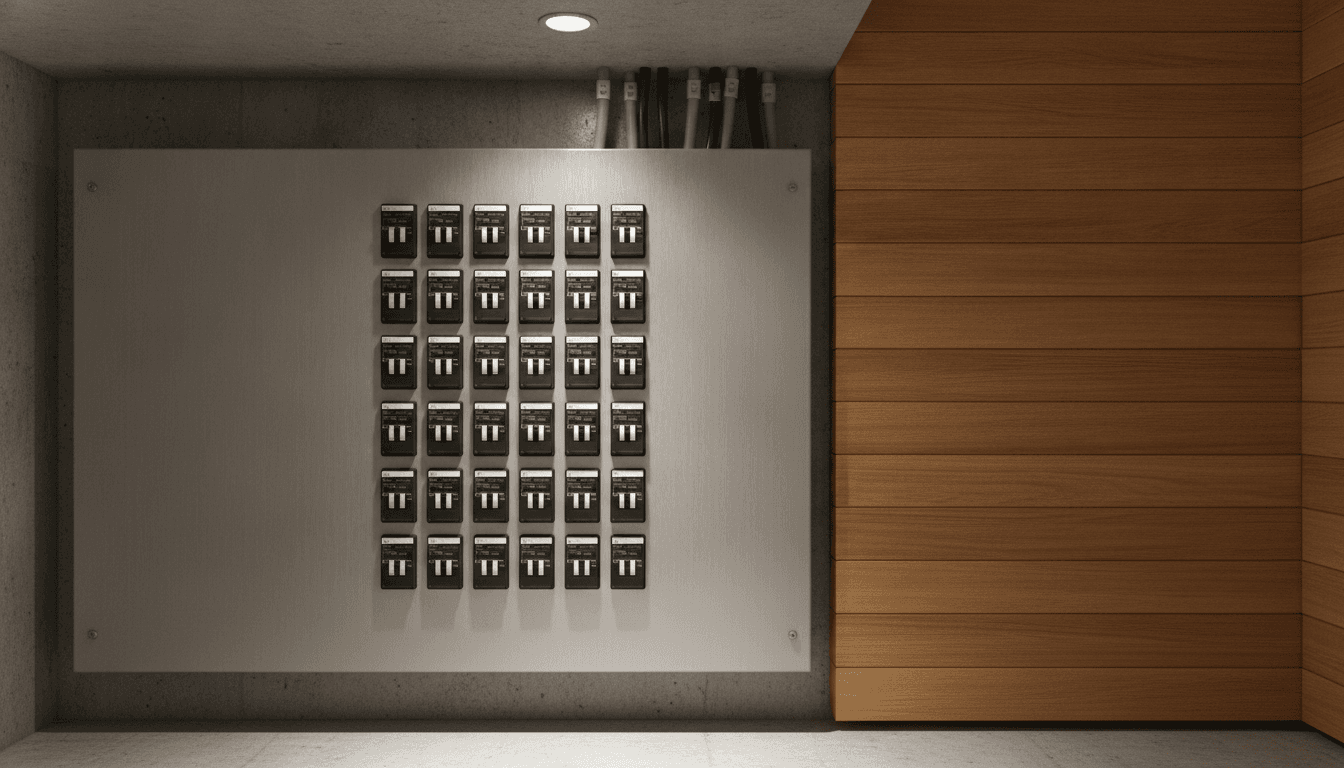
Brand and features round out the list. A standard 40-space Square D, Eaton, or Siemens 200-amp panel costs $250 to $500 for the box and breakers. Adding a whole-house surge protector adds $150 to $400, and AFCI or GFCI breakers required for updated circuits run $40 to $70 each versus $8 for a standard breaker.
The Federal Pacific and Zinsco Question
Thousands of New Jersey homes built between the 1950s and 1980s still have Federal Pacific Electric Stab-Lok panels, which are known for breakers that fail to trip. Replacing one is a standard 200-amp swap, but some insurance carriers in the state will not write or renew a policy until it is done, so this upgrade sometimes comes with a deadline attached.
Zinsco and Sylvania-Zinsco panels have a similar reputation. If a home inspector flags either brand during a purchase in Toms River or Woodbridge, buyers often negotiate the $2,500 to $4,000 replacement cost into the sale.
When an Upgrade Is Worth Doing
An EV charger is the most common trigger. A Level 2 charger draws 40 to 50 amps on its own, and a 100-amp panel that is already feeding central air, an electric dryer, and a water heater has no room for that load without a service upgrade or a load management device.
Heat pumps are the second trigger, and New Jersey's incentive programs have pushed a lot of homeowners toward them. A cold-climate heat pump with electric backup strips can add 30 to 60 amps of demand, and pairing that with a heat pump water heater often pushes a 150-amp home past its limit.
Solar is a third. Many New Jersey solar installs require a panel with a 200-amp bus and a main breaker that leaves room for the backfeed breaker under the 120% rule. If your current panel cannot accommodate that, the upgrade becomes part of the solar quote.
If none of those apply and the panel is simply old, an electrician can run a load calculation for $100 to $250 and tell you whether the existing service has capacity. Sometimes the honest answer is that a 150-amp panel is fine for another decade.
How to Get a Fair Price
Three quotes is the right number. Panel upgrade pricing in New Jersey varies by 30% to 50% between contractors for the same job, mostly because of differences in overhead, scheduling, and how conservatively each electrician estimates the unknowns.
Ask each contractor to break the quote into the panel and breakers, labor, permit fees, and utility coordination. A single lump-sum number makes it impossible to compare, and it hides the moment when a "$3,200 panel upgrade" becomes $4,800 because the grounding was not included.
Confirm the electrician holds a current New Jersey electrical contractor license and business permit, and that the license number on the quote matches the state database. You can start your search among licensed electricians in your county and then verify each one before scheduling a site visit.
Schedule the job for a weekday when your utility offers a standard disconnect window. Weekend and emergency service upgrades in New Jersey can add $500 to $1,000 in premium labor. For more on comparing trade quotes and spotting inflated bids, the home services blog covers what to look for line by line.
Frequently Asked Questions
Do I need a permit for a panel upgrade in New Jersey?
Yes. New Jersey's Uniform Construction Code requires an electrical permit and inspection for any panel replacement or service upgrade, and the licensed electrical contractor is responsible for pulling it. Skipping the permit can create problems when you sell, since the buyer's inspector will ask for the sign-off.
How long does a 200-amp upgrade take?
Most same-location swaps take four to eight hours, and the power is off for most of that time. A full service upgrade with a new mast and meter base usually takes a full day, with the utility reconnect sometimes happening the same afternoon or the next morning.
Will my homeowners insurance pay for a panel replacement?
Almost never, unless the panel was damaged by a covered event like a lightning strike or a fire. Some New Jersey carriers do require replacement of Federal Pacific panels as a condition of coverage, which is a reason to do the work but not a source of funds for it.
Can I upgrade from 100 amps to 200 amps without a new service drop?
Sometimes. If the existing service entrance cable and meter socket are rated for 200 amps, which is common in homes built after the mid-1980s, the electrician can replace only the panel. Older service drops rated for 100 amps require the utility to upgrade the line, which is part of the full service upgrade price.
Is a 400-amp service overkill for a New Jersey home?
For most homes, yes. A 400-amp service makes sense for houses over 4,000 square feet with two EV chargers, a heat pump, a pool, and an accessory apartment, but a well-planned 200-amp panel with load management handles the majority of electrification projects at half the cost.